July 26, 2010
How Do You Say "Reason" in Chinese?
July 7, 2010
Wasted Possession: Alcohol and Hangovers in China
July 5, 2010
Spurning Soccer For Basketball: An American Sports Epidemic
June 26, 2010
A Sick Move, I
Indeed, I still make the trek over to SNU sometimes. But Li Ball’s court, which is right up the street, has supplanted it as my favorite place to play for reasons that transcend proximity (although in a city of millions with shoddy public transportation, and with a motor bike that is broken as often as it’s not, proximity does play a factor). The backboards at Li’s court are glass, the balls are always properly inflated (and won’t scrape the clouds like they often do at SNU), the court is perfectly flat. The flatness of a court, at home, would be a no-brainer – like saying an infield had dirt. But in China, where cracks and divots and cancerous lumps dot courts everywhere, having a flat court is a veritable luxury.
Li Ball is the one in the white shirt.
And then there are the players themselves, starting with Li Ball, who I like to think of as the court’s Don Corleone. There he is, after the games have ended, welcoming the players over the base of the goal where he sits to cool down. “What is it?” he would say. “What can I do for you? You know I can’t say no on the day of a basketball game.”
Even if Li doesn’t possess Corleone-type power, he is nonetheless the most prominent figure at the courts. He is the one who always calls me to play; he is the one who dictates the teams; and often times instead of playing he’ll instead stand attention along the sidelines, dishing out officiating decrees and announcing the score in a way that is never questioned. This is a welcome change from the games I used to play at my old stomping grounds, 24 Hours Fitness in Kansas City, Mo. There, berserk argument would erupt about the score at least once a week. There was of course bickering about foul call, which is to be expected. But the score is the one thing that is subject to the unbending edicts of mathematics, and even that would inspire incredulous shouting and cussing the likes of which never failed to make me laugh (and cringe) with exasperation. Sometimes when these arguments would flare up, I would just dip out in the hallway and get a drink of water while people bitched about the score. All too often, nothing was settled when I came back. Part of the problem was ego; part of the problem was that if a team lost, they could be sitting for up to 30 or 40 minutes. Thus, no one wanted to lose, even if it meant forgetting/flubbing the score in your favor.
There is none of that hear, though. Li Ball is in control.
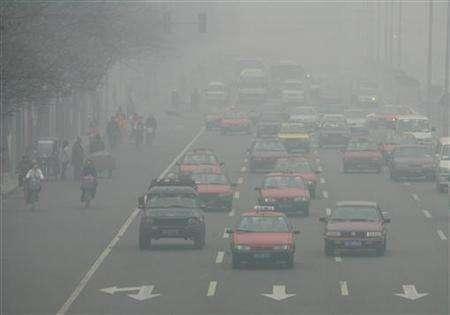
There even seems to be less smog when I play at this court.
The other players are cool too. I have been introduced to them all, but for the life of me I can’t remember their names (save the short fat dude who introduced himself as Tom). I know their faces, though, and I have even run into a couple of them out on the streets of Jinan, never far from the courts themselves. They range in age from young (a handful of 20-somethings) to old (30 to 45). Before long I’ll join that second segment of the playing population, all those 30-plus year-olds who have lost their hops and have to increasingly rely on guile to get things done on the court. Thankfully, I’m not at the age yet. I still have a few ounces of athleticism floating around in my legs, though I know it will soon leak out. There are a few other guys who still possess my sprightliness, and I invariably end up guarding them. (Linguistic note: In America, defensive lingo is always a variation of the verb have. Something like, “I have this guy,” or, “I’ll get him,” or, “I got ball.” In China, the verb for playing defense it look or watch, as in, “You watch him,” which translates to “Ni kan ta.” – “You look him.”)
Bottom line, the court is great, there are always games to be played, and everyone is nice – no malicious elbows to the head, no long stints sitting – even if you lose. As such, Li Ball is who I call if I want to play.
A Sick Move, II
Now, basketball is hardly a sanitary activity. Really, anytime a bunch of guys are clamoring to handle something (cards, video game controllers, etc.), it pretty much can’t be clean. I get that. But when you look at your hands after playing a few minutes of basketball in China…wow. It’s disgusting.
And while it could well be true that dirt isn’t all that dirty, it’s not just dirt that makes China dirty. Which brings us to a larger point about China in general. Like Li’s court, it’s dirty as hell. The polluted air is what you hear about when people talk of how dirty China is, and that’s not an exaggeration. But now that I’ve been here for 10 months, the smog’s not even what bothers me anymore. It’s the dirtiness, the germiness.
I came to China a little on the OCD side about germs. But instead of curing me of my germ aversion, China has merely made me more sensitive to it. And there are any number of things that Chinese people do that are downright gross. (Having now reread this post, I don’t know if there is any way for me to make this not sound discriminatory: the Chinese do a lot of gross stuff. But at the same time, I don’t know if there is any way to dispute the claim that, by the American standards I grew up with, it’s not true. That’s not to say the Chinese are stupid or mean or savage or lesser. I’m just saying that they have some tendencies that would never fly in America – just like Americans have tendencies that wouldn’t fly in China. I know that I am speaking from an American viewpoint, not a privileged viewpoint. Heck, maybe America is just too sensitive to cleanliness. This article and this article seem to hint at just that.)
You can’t walk one block on any remotely-populated street and not hear someone make a deep, guttural hacking sound – a telltale prelude to a huge loogy. Just yesterday I got off a train (I spent the last 10 days in Chengdu, hence the dearth of recent posts), and at the exit gate I looked down to see a pair of stringy, yellow-green clusters of stuff that used to reside in the area between someone’s mouth and lungs. To be fair, at least this person cleared their throat after they got off the train, which is more than can be said for innumerable people who added that putrid, hacking noise to the soundtrack of the 30-hour train ride. And in a land of 300,000,000 smokers, I can assure this is a never ending soundtrack. The staircases at my school, where parents conglomerate to wait for their children, are another hotbed for spitting. Really, all of China is a hotbed for spitting.
Then there is also the move where people blow their noses, but without a handkerchief or Kleenex. They just send the contents of their nose jutting toward the ground. When I was a kid we called this the “Texas Air Hanky.” The last time you saw it was either during a hockey game or on the streets of China.
It is also not uncommon to see little (or big) piles of vomit resting at the base of a tree. If you have to puke then you have to puke; I get that. But I’ve seen more ground vomit in my eight months in China than I did in my 24 years in America. And I’ve been to a lot of bars in America.
People are also apt to relieve themselves on sidewalks. “People” in this case could mean everyone from itty-bitty toddlers (who wear crotch-less pants for quick and painless popping-and-squatting) to old men (who know better but just don’t care). Quick story about public relief of the excretory system: my mom, dad and I came to visit my brother in China a few years back, and on a plane from Xian to Guilin, my dad was the odd man out on a seat, stuck sitting on the other side of the aisle from my brother, mom and I, who controlled our own three-seat section of the plane. Pa was wedged next to a little kid who was wearing the bottomless pants. (If you’re having trouble imagining what this looks like, just think if you cut a big oval-shaped hole in your jeans from the top of your zipper, through the legs, back around to the midway point of the seat. Or you could just >look here.) Well, this kid – seated about five-and-a-half inches from my dad – unloads his bowels then and there, right after takeoff. It gets on the mom a little bit, and while it didn’t actually touch pa, he nonetheless got an eyeful of doodoo. It was a cultural experience he could never have had in a land where parents, you know, make their kids wear diapers.
This may all seem like superficial stuff. OK, so there is spit on the ground. So there is a little puke tucked against the base of the occasional tree. So kids relieve themselves everywhere, but who has ever been successful telling a 14-month-old when and where to go? (Anyway, is having a bunch of soiled diapers that much cleaner than the occasional puddle?)
The thing is, it’s not all superficial. The eyesores are accompanied by a host of things are more than just eyesores. It really is dirty – and not just dirt dirty. It’s really dirty.
There are, for instance, no soap dispensers in public restrooms, save nice restaurants. (Beijing and Shanghai pay a little more heed to soap, but like I’ve said, Jinan ain’t no Shanghai.) The bathrooms at our school feature puddles of piss, and soap dispensers with soap that’s so watered-down it surely houses more germs than it prevents.
And it isn’t just our crummy school. It’s the country at large. There wasn’t a drop of soap on the train I got off yesterday. The people who handle the food you buy off the street don’t wear gloves on their hands – just a discernable layer of brownish crud that can’t possibly be clean. And those Texas Air Hankies don’t just happen on the street. The last time I went to McDonald’s someone was pulling the time-trusted maneuver in the sink in the dining area.
Like so many of the things I talk about on this blog, the germiness of China is hard to quantify (heck, germiness isn’t even a real word). How the Chinese are always drinking hot water, how much the Chinese like to stretch, how much counterfeit clothing there is: these things are all observable, but not necessarily measurable.
The same goes for the sanitation conditions. I haven’t the scientific prowess to conduct a study of the actual germiness of China – just the time and inclination to write about it and to make up words to describe it.
But even if I can’t convey in any sort of statistical way just how germy it is in China, I can rehash an event that beats home the sanitation issue.
After a 24-hour trip that started in Kansas City, I landed in Beijing in early September. If you recall, early September was at the height of the H1N1 craze – that is, the Pig Flu craze – and people were all in a tizzy about it. Especially in China. This article, for instance, entitled “China faces grim situation as H1N1 escalates,” was published the very day I landed in China. The country took to quarantining people – like this guy, a professor from the University of Michigan, and this guy, the mayor of a major U.S. city. If you rode on a plane with someone who turned out to be sick, you could be quarantined. If you coughed a little bit too much, you could be quarantined. If you looked extra fatigued, you could be quarantined.
As another precaution, there was a rapid spread of what looked like little plastic handguns that, when stuck up to someone’s forehead, gave a quick temperature scan. One of these guns/thermometers was pressed against my forehead as I exited the plane in Beijing. I was a little bit nervous, because anything from the mildest of temperature abnormalities to a slight technical malfunction could have landed me in a Chinese quarantine, something I’d rather not see first-hand.
By the grace of God, I waltzed through the sickness-detection chamber A-OK. (I was, after all, in fine health.) But after the lengthy flight and comp coffee, I needed to hit a bathroom when I got on the ground, so I headed for the nearest bathroom. It was just like an American airport bathroom – a cavernous room with urinal upon urinal against a teal-green wall. I relieved myself and, when I was heading out, beelined toward the sink to rinse up. The American equivalent to this WC would have had a bounty of soap and a hand sanitizer dispenser as well, just in case you’re too lazy to actually wash. (Even the Kansas City airport has hand sanitizer dispensers, so it can’t be that far-out of an addition. Like I said, I’ve always been a bit of a germophobe, so I notice these things.)
Alas, there was no soap in the bathroom. So one moment I was getting my temperature taken, an obligatory procedure that could well have landed me in a quarantine because Chinese officials are paranoid (justified or not) about the spread of H1N1. The next moment, I am taking a leak in a bathroom that doesn’t have any soap.
Li Ball’s court doesn’t have any soap either.
June 8, 2010
Is it In You? Well, It's In China
There is a pizza place in particular that has become a staple of my diet. I found it almost by accident, which, unless someone took you there, is the only way you could find it. It is located on a street that looks like any old street in Jinan. To the left of the restaurant is a karaoke bar and clothing store; to the right is an alley and a lady selling a variety of snacks and drinks out of her mobile store, which is little more than a wide, non-functioning refrigerator with wheels.
Most restaurants that boast foreign food in China are descript – that is, they are designed and marketed in such a way that you know they aren’t your run of the mill, rice-and-whatever restaurant. KFC, for instance, which is huge here in China, always boast huge cutouts of Colonel Sanders smiling invitingly at would-be customers down on the street. McDonald’s, also huge here, flaunts those golden arches at least as much as they do back home. And Pizza Hut – which price-wise is nothing less than fine dining in Jinan – has two locations here, each of which are encased by flashy walls of windows looking in, and table after table of affluent customers looking out.
Indeed, if a restaurant has foreign food on the menu, then a restaurant is something of a novelty (at least in Jinan). And if your restaurant is a novelty, then there is a good chance that you will let passersby know that your restaurant is a novelty by advertising, and advertising loudly.
But this restaurant doesn’t do that. Nope, it’s just slipped onto Any Street, with a nondescript green door acting as the gateway into an awesome (and reasonably priced) dining experience. They have pasta and French Fries and, above all, a variety of pizzas. All-veggie pizzas. All-meat pizzas. All-cheese pizza. And, my personal fave, The Hot One, which is decked with spices and peppers and all sorts of other goodness that you could expect from a legitimate pizzeria.
What makes this place all the more endearing is that the whole scene looks like a pizza joint from any college town in America. When you open the door, there is a 25-foot-long strip of the wood floor cutting down the middle of the narrow interior, leading to another door – this one with the top half cut out – that leads to the kitchen. On either side of that walkway are tables. The first six are tables with chairs; the ones closest to the kitchen are booths.
After my girlfriend and I eat our pizzas and play Scrabble for like two hours, she indulges me in a trip to a nearby basketball court. It’s 9:45 and dark, but these particular courts, which we stumbled upon last week, house basketball well into the night.
It’s a bizarre scene, unlike anything I’ve seen in America. There are maybe 20 courts, each partially lit by varying levels of light radiating from the streetlamps on the adjacent street. The courts are situated on the edge of a university campus, and the players who are shooting around tonight reflect that demographic. Guys (and one girl) from the ages about 18-20 are beating balls into the ground across a swath of land that spans about three-fourths the area of a football field. There are so many players, and so many balls, that it sounds like the basketball camps held at my old high school, where a few hundreds kids would squeeze into the high school gym and frantically run drills with the omniscient thwack of the balls resonating throughout the fieldhouse. Of course, there is no field house here. But the acoustics are such – what with the sprawl of concrete – that it is a veritable echo chamber, like a series of loudspeakers surround the area and are pumping in nonstop thwacks.
Tonight I am just snooping around, opting not to play on account of the nine-inch pizza and three beers occupying my stomach. But I do survey the scene with intrigue. It is kind of eerie, the way everything looks and sounds. You can make out where the people are, but the light is so faint on some of the courts that people are merely silhouettes, the noise of the ball revealing as much as anything you can actually see. You can tell that shots are getting lofted rimward, but with no nets, the only way to decipher between a make and a miss is to listen for the metallic clank of the rim. If there is a thud, they missed. No thud equals a make. Or an airball.
Luckily there are some things more discernable than makes and misses. Like, say, the plethora of sports drinks lining the sidelines. Unlike myself, the kids playing ball tonight have opted against beer, and are instead imbibing in bottles of Gatorade, which are sold – along with ice cream, candy and cigarettes – at a kiosk near the entrance. Seeing these bottles of Gatorade is nothing new, for Gatorade has, like adidas and the aforementioned KFC, made a concerted push into the Chinese market.
And the success of this push – and it has indeed been successful – is no doubt linked to Gatorade’s strategic marriage to basketball.
The ubiquity of Gatorade bottles now, in June of 2010, can be linked to a marketing move made back in March of 2007. It was back in ’07 that Gatorade expanded its relationship with the NBA, which itself was increasing its popularity march around the globe, in an effort to tap into Asian markets, China in particular. From the Sports Business Journal:
And from the Sports Business Daily:
Gatorade has expanded its NBA marketing partnership to include China for the first time as part of a multi-year renewal….
Gatorade, the official sports drink of the NBA, WNBA and NBA D-League, is also continuing to work with the NBA on a weekly basketball reality show called “NBA Zhi Zao” (“Made in the NBA”), which airs on 43 channels in China…
The move appears to have paid dividends. Not only is Gatorade the drink of choice the courts tonight, but also over at Shandong Normal, where Wang, the Refreshment Man, peddles Gatorade side-by-side with his water. And along with cigarettes, the chain-smoking dudes from that other university were indulging in bottles of Gatorade between games. (It’s unclear if Gatorade’s physiological properties can outweigh the effects of a pack of cigarettes, but that seemed to be what they were trying to figure out.)
And it’s not just basketball courts. You can find a bottle of Gatorade at any street shop (of which there are an infinite amount), and the sports drinks section at supermarkets are invariably huge. At least some of this boom is the result of Gatorade’s 2007 partnership with the NBA, a move that was in no way haphazard.
While PepsiCo, which owns Gatorade, has already invested heavily in China, and while anecdotal evidence (such as Gatorade-lined basketball courts) suggests that PepsiCo products like “G” are already going strong here, the company recently announced plans to pour even more money into the Chinese market. From the Associated Press:
PepsiCo Inc. said Friday that it plans to invest an additional $2.5 billion in China in the next three years on new plants and research facilities as the food and beverage maker builds up its presence in the growing market.
The company made the announcement in a news release Friday from Shanghai, site of the Shanghai Expo, where PepsiCo is a sponsor of the USA Pavilion. That planned spending is in addition to the $1 billion investment it announced in 2008 and plans to complete this year….
Money from PepsiCo's additional investment in China will be used to open 10 to 12 new manufacturing plants, create a new research and development center, open five new farms for potatoes and oats and to build its brands.
The company will research and develop new products just for the Asian market. It already offers drinks inspired by traditional Chinese medicine and Lay's potato chips in flavors tailored just to the market, including cool cucumber and crispy prawn.*
"We are building expertise and infrastructure now so that we can have a strong, sustainable manufacturing and agricultural base to serve the diverse and growing needs of consumers across China," Chief Executive Indra Nooyi said.
* I can attest that these are as nasty as they sound.
On an editorial note (do I need to specify that on a blog?), it is impressive what PepsiCo has done in China. PepsiCo not only owns Gatorade, but also some other successful enterprises in China. As I mentioned earlier, KFC and Pizza Hut are both big-time chains in China, and each is owned by PepsiCo (or, more accurately, by Yum! Brands, which was spawned by PepsiCo to handle the company’s restaurants).
It’s not at all uncommon for kids in class, when game time rolls around, to blurt out “Team KFC!” when I ask what they want their team name to be. Moreover, each of the three Jinan branches of my school have KFCs within walking distance; one of the schools has two KFCs within walking distance. And Pizza Hut is nothing less than fine dining in Jinan. I have only eaten there once, but on that one occasion I dropped more than 100 yuan for dinner. Convert it back to dollars, and it’s about the same that you’d pay back home. Anytime you convert something from yuan to dollars and it’s the same as you’d pay back home, you know that you’re spending a pretty penny for whatever it is that you happen to be buying. Tropicana juice and Doritos brand chips are also staples in Jinanese stores, and both of them are also owned by PepsiCo.
And tonight at least, PepsiCo also owns the sidelines.
June 1, 2010
Kicking It at a Soccer Game
Nonetheless, Sundays kick my ass. I teach from 8:00 to 5:15 each Saturday, and then turn around and clock an 8:00-to-7:00 shift on Sunday. Even if you’re just dicking around with kiddos and concocting variations of basketball and bowling that can be played in the confines of a hot, cramped classroom, working 11 straight hours will drain you. Sure, it’s not the same fatigue that a physicist has after a long day of crunching numbers, or the fatigue that a college student has after churning out a trio of final exams in one week. But still, Sundays are brutal.
But somehow, I summon the energy at the end of day today, Sunday, to join some co-workers for a professional soccer match here in Jinan. Jinan is home to Shandong’s team in the Chinese Super League, which is China’s (bastardized) equivalent to the English Premiership or the German Bundesliga. Founded in 2004, the CSL has 16 teams. Shandong won the whole thing in 2008 and 2006, and last season the squad finished fourth. So we have a decent side to support.
I get off work at 7:00, hop on my bike and take a 10 minute jaunt over to Shandong Provincial Stadium, which I’ve driven past but never been inside. With the setting sun as the backdrop, I can see the stadium from at least a half-mile away. I can’t tell if it is an abomination or an interesting bit of architecture. It is shaped like an oval and dwarfed by four massive banks of lights jutting inward, like they used to stand upright but have since been slanted by a microburst. Built in 1988, it has some vague, fleeting sense of communism. Every inch of it is gray, and the flashing neon lights that dot the upper perimeter don’t hide the fact that the structure itself is utterly devoid of color – and life. It’s like they went out of their to build it in such a way that no one could possibly have any opinion about it, good or bad.
I don’t know if they’re going to sell beer inside, so I stop and buy four cans of Tsingtao at a nearby supermarket. (Interestingly, Tsingtao cans have more alcohol than the bottles – 4.3 percent to 3.1 percent.) I park my ride at a nearby intersection, which has turned into a quasi-parking lot, and pay the overseer one yuan for her trouble. She is probably 65 years-old and walks with a noticeable limp. As I’m locking up my bike, she keeps on pointing to my basket, which holds an old, falling-apart pair of shoes (which act as my brakes). I reckon that she is telling me that she’s not responsible if the shoes get stolen, but if someone steals those things, they probably need them more than I do.
I weave my way through the throngs of people hocking tickets. It’s not entirely clear whether they are sanctioned ticket vendors or scalpers, and I don’t have the linguistic chops to figure that out. One of these vendors/scalpers is literally standing at the window for the actual ticket office when I get there. He points to a map of the stadium as he tries to coax me into paying 200 yuan for a ticket that is apparently worth 300 yuan. But I have no intention of paying even 200, especially when my objective is to simply get in and find my friends who are already inside (they don’t have to work until 7, like I). I pay 30 yuan for a ticket and walk over to the line to get in.
In an exchange that is 40 percent speaking and 60 percent pointing, I ask a security guard if it’s cool for me to take some beers into the venue. I have little doubt that it’s allowed because, after all, you can take beer almost anywhere in China (or at least Jinan). You can B.Y.O.B. at restaurants, and no one will think twice if you are walking down the street with a brew or even if you hop on a bus toting some suds. Not that it’s common to see people traipsing around with beer, but it’s certainly not a huge deal. This phenomenon of unmitigated drinking prompted one of my co-workers’ friends to opine, after a visit to China, that people in China are freer than people in America. In the case of alcohol, it’s probably true. (In the case of the media, Internet and a semblance of a democratic legal process, it’s probably not true.).
Alas, the security guard delivers the bad news that you can’t bring your own beer, and I am left with a slight conundrum: should I down these four beers as quickly as I can and miss the first several minutes of the game (which has just begun), or should I part with the booze in exchange for catching all the action. That’s when I remember that it’s soccer, not basketball, and as such there IS no action. (Mandatory dis on soccer for being boring, check). I trade 12 minutes of game time for the four beers, then I go in.
Once in, I set out to find my buddy Toby. Working against me are the facts that I have no idea where he is, that this is a 40,000-seat stadium and that I’m slightly buzzed. Working in my favor is the fact that Toby is a 6-5 black dude, and in China, 6-5 black dudes are about as common as teetotalers at Mardi Gras. It takes me all of three or four minutes to spot Toby, who is sitting just about parallel with the end line on the west side of the stadium. I join him and his Chinese girlfriend for the remainder of the first half, which thoroughly dispels my notion about soccer being devoid of action. In the 30 minutes that I catch, there are three goals (two by Jinan), and two more shots clank off the crossbar. In addition, there are a pair of sizeable scuffles – big enough to prompt guys to enter the fray from the bench and for the ref to give guys yellow cards. It’s actually pretty exciting.
The fans also add to the entertainment. Now, the place is still empty – there are probably 12,00 people. But the fans who are in attendance are doing a hell of a job making it feel lively. Part of that zest manifests in timely, knowledgeable cheering. And part of it comes in the form of venomous chants directed at the other team’s fans. That venom may be due to the fact that the opponent was from Hunan, and according to Toby’s girlfriend, Hunan doesn’t have the best reputation in China. I don’t have any proof of Hunan’s shady underbelly – and neither does she. But when it comes to vilifying and discriminating against people for nothing more than their place of birth, you can argue that rumors and perception are (at least) as important as the facts. With disdain in her voice, Toby’s girl says that Hunan is known for criminals, and that it is the epicenter or China’s vast fake clothing market. Again, I don’t know if this girl was spitting facts or B.S., but she took them to be fact, and that’s what’s pertinent here. The hatred being spewed toward the Hunan fans backed up the idea that Hunan is indeed loathed, at least by people from Shandong.
The Hunan cheering section, which is off to the left as I look at the field, is small. There are probably 200 people wearing Hunan jerseys, waving Hunan flags, and chanting Hunan chants in a sectioned-off nook of the stadium behind the north goal. There are nearly as many security guards sitting in that section as there were fans, to either prevent or protect. The Shandong fans are shouting and pointing quite a bit during the first half, especially when the little scuffles broke out, but that disdain only intensifies after the break. Hunan quickly knots the score at two apiece, and this seems to galvanize their supporters. They are boisterous as ever, and when Shandong makes a few substitutions, the Hunan fans start up a chant that, according to Toby’s girlfriend, was something to the effect of, “You switch one c*^t for another c*^t!” There are all sorts of other things being chanted and yelled, but Toby’s girlfriend can’t quite make it out. Suffice it to say that they aren’t well-wishes.
As for the actual soccer, it’s not that great. Even I can tell that there are a lot of flubbed chances. There is one play in particular where the Hunan defender falls flat on his ass, allowing a Shandong player to race unabated up the sideline with the ball. Somehow, despite being handed a golden opportunity, the team doesn’t so much as get off a shot. And then there is another play by Hunan where they have a free kick from about 25 yards out. One player taps the ball to his right, directly in the path of a streaking teammate who is all geared up to smash the ball goalward. Well, he smashes it all right – about 20 feet over the crossbar. He was roundly applauded and mocked by the crowd, but truth be told, he is no worse than any of Shandong’s players.*
* Quick note: as is the case with professional basketball in China, professional soccer teams are allowed only a few foreigners. Shandong’s foreigners are Fred Benson (Netherlands), Siniša Radanović (Serbia) and Carlos Santos de Jesus (from Brazil, by way of Croatia), and Roda Antar (born in Freetown, Sierra Leone). None of them appear to be any good.
After the game, I say goodbye to my friends and walk along the sidewalk toward the intersection housing my bike. As I walk, I notice a throng of Shandong fans conglomerating on the north side of the stadium. They are yelling with great hostility, but when I look at the stadium to see who they are yelling at, I see no one. The crowd and the yelling swell, and the tangible sense of hostility intrigues me to the point where leaving is out of the question. I join the throng, unable to deduce what’s going but hopelessly curious nonetheless.
Eventually people in the crowd take to throwing water bottles at the stadium. The stadium has two tiers, and they are launching them at the upper tier. I immediately feel bad for whatever poor sucker(s) is standing on the concourse up there, but upon inspection, there is no one standing there. It’s just an empty concourse and a 10-foot-wide entryway into the a section of seats. Yet the Shandong fans keep chucking, bottle after bottle. A roar goes up when one of the bottles finds its way into the entryway; that’s where they are aiming. More and more bottles are launched at that entryway. At this point it becomes like that scene from Independence Day where all of the planes take aim at the alien spacecraft – that entryway is the spacecraft, the people are the planes, the bottles the missiles. I still can’t tell what’s going on though, but the bottles keep flying.
Finally, I conjure up an image of the stadium in my head and realize that this entryway – which is labeled with a giant “7” – must be just about where the Hunan fans’ section was. Yeah, that’s about right: I was sitting along the end line, to the west, and then I exited and walked around the north end of the stadium, which is where I am now. The Hunan section was to my left as I watched the game – to the north, that is – and now there are hundreds of people standing around the northern concourse, more than a few of them hurling water bottles at the entrance into the section of seating that must have been at least close to the Hunan sheering section.
The cops eventually break up the bottle-throwing party and I gladly head home. It would have been fun to see what transpired had the Shandong fans been allowed to persist, but at the same time I’m pretty tired. It is, after all, Sunday.
Should anyone have read this and expected it would at some point turn to basketball, I promise we’ll get back to hoops soon…