July 7, 2010
Wasted Possession: Alcohol and Hangovers in China
June 26, 2010
A Sick Move, II
Now, basketball is hardly a sanitary activity. Really, anytime a bunch of guys are clamoring to handle something (cards, video game controllers, etc.), it pretty much can’t be clean. I get that. But when you look at your hands after playing a few minutes of basketball in China…wow. It’s disgusting.
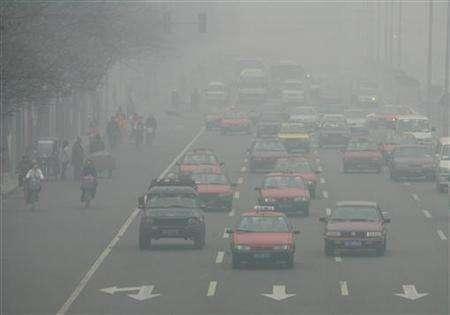
And while it could well be true that dirt isn’t all that dirty, it’s not just dirt that makes China dirty. Which brings us to a larger point about China in general. Like Li’s court, it’s dirty as hell. The polluted air is what you hear about when people talk of how dirty China is, and that’s not an exaggeration. But now that I’ve been here for 10 months, the smog’s not even what bothers me anymore. It’s the dirtiness, the germiness.
I came to China a little on the OCD side about germs. But instead of curing me of my germ aversion, China has merely made me more sensitive to it. And there are any number of things that Chinese people do that are downright gross. (Having now reread this post, I don’t know if there is any way for me to make this not sound discriminatory: the Chinese do a lot of gross stuff. But at the same time, I don’t know if there is any way to dispute the claim that, by the American standards I grew up with, it’s not true. That’s not to say the Chinese are stupid or mean or savage or lesser. I’m just saying that they have some tendencies that would never fly in America – just like Americans have tendencies that wouldn’t fly in China. I know that I am speaking from an American viewpoint, not a privileged viewpoint. Heck, maybe America is just too sensitive to cleanliness. This article and this article seem to hint at just that.)
You can’t walk one block on any remotely-populated street and not hear someone make a deep, guttural hacking sound – a telltale prelude to a huge loogy. Just yesterday I got off a train (I spent the last 10 days in Chengdu, hence the dearth of recent posts), and at the exit gate I looked down to see a pair of stringy, yellow-green clusters of stuff that used to reside in the area between someone’s mouth and lungs. To be fair, at least this person cleared their throat after they got off the train, which is more than can be said for innumerable people who added that putrid, hacking noise to the soundtrack of the 30-hour train ride. And in a land of 300,000,000 smokers, I can assure this is a never ending soundtrack. The staircases at my school, where parents conglomerate to wait for their children, are another hotbed for spitting. Really, all of China is a hotbed for spitting.
Then there is also the move where people blow their noses, but without a handkerchief or Kleenex. They just send the contents of their nose jutting toward the ground. When I was a kid we called this the “Texas Air Hanky.” The last time you saw it was either during a hockey game or on the streets of China.
It is also not uncommon to see little (or big) piles of vomit resting at the base of a tree. If you have to puke then you have to puke; I get that. But I’ve seen more ground vomit in my eight months in China than I did in my 24 years in America. And I’ve been to a lot of bars in America.
People are also apt to relieve themselves on sidewalks. “People” in this case could mean everyone from itty-bitty toddlers (who wear crotch-less pants for quick and painless popping-and-squatting) to old men (who know better but just don’t care). Quick story about public relief of the excretory system: my mom, dad and I came to visit my brother in China a few years back, and on a plane from Xian to Guilin, my dad was the odd man out on a seat, stuck sitting on the other side of the aisle from my brother, mom and I, who controlled our own three-seat section of the plane. Pa was wedged next to a little kid who was wearing the bottomless pants. (If you’re having trouble imagining what this looks like, just think if you cut a big oval-shaped hole in your jeans from the top of your zipper, through the legs, back around to the midway point of the seat. Or you could just >look here.) Well, this kid – seated about five-and-a-half inches from my dad – unloads his bowels then and there, right after takeoff. It gets on the mom a little bit, and while it didn’t actually touch pa, he nonetheless got an eyeful of doodoo. It was a cultural experience he could never have had in a land where parents, you know, make their kids wear diapers.
This may all seem like superficial stuff. OK, so there is spit on the ground. So there is a little puke tucked against the base of the occasional tree. So kids relieve themselves everywhere, but who has ever been successful telling a 14-month-old when and where to go? (Anyway, is having a bunch of soiled diapers that much cleaner than the occasional puddle?)
The thing is, it’s not all superficial. The eyesores are accompanied by a host of things are more than just eyesores. It really is dirty – and not just dirt dirty. It’s really dirty.
There are, for instance, no soap dispensers in public restrooms, save nice restaurants. (Beijing and Shanghai pay a little more heed to soap, but like I’ve said, Jinan ain’t no Shanghai.) The bathrooms at our school feature puddles of piss, and soap dispensers with soap that’s so watered-down it surely houses more germs than it prevents.
And it isn’t just our crummy school. It’s the country at large. There wasn’t a drop of soap on the train I got off yesterday. The people who handle the food you buy off the street don’t wear gloves on their hands – just a discernable layer of brownish crud that can’t possibly be clean. And those Texas Air Hankies don’t just happen on the street. The last time I went to McDonald’s someone was pulling the time-trusted maneuver in the sink in the dining area.
Like so many of the things I talk about on this blog, the germiness of China is hard to quantify (heck, germiness isn’t even a real word). How the Chinese are always drinking hot water, how much the Chinese like to stretch, how much counterfeit clothing there is: these things are all observable, but not necessarily measurable.
The same goes for the sanitation conditions. I haven’t the scientific prowess to conduct a study of the actual germiness of China – just the time and inclination to write about it and to make up words to describe it.
But even if I can’t convey in any sort of statistical way just how germy it is in China, I can rehash an event that beats home the sanitation issue.
After a 24-hour trip that started in Kansas City, I landed in Beijing in early September. If you recall, early September was at the height of the H1N1 craze – that is, the Pig Flu craze – and people were all in a tizzy about it. Especially in China. This article, for instance, entitled “China faces grim situation as H1N1 escalates,” was published the very day I landed in China. The country took to quarantining people – like this guy, a professor from the University of Michigan, and this guy, the mayor of a major U.S. city. If you rode on a plane with someone who turned out to be sick, you could be quarantined. If you coughed a little bit too much, you could be quarantined. If you looked extra fatigued, you could be quarantined.
As another precaution, there was a rapid spread of what looked like little plastic handguns that, when stuck up to someone’s forehead, gave a quick temperature scan. One of these guns/thermometers was pressed against my forehead as I exited the plane in Beijing. I was a little bit nervous, because anything from the mildest of temperature abnormalities to a slight technical malfunction could have landed me in a Chinese quarantine, something I’d rather not see first-hand.
By the grace of God, I waltzed through the sickness-detection chamber A-OK. (I was, after all, in fine health.) But after the lengthy flight and comp coffee, I needed to hit a bathroom when I got on the ground, so I headed for the nearest bathroom. It was just like an American airport bathroom – a cavernous room with urinal upon urinal against a teal-green wall. I relieved myself and, when I was heading out, beelined toward the sink to rinse up. The American equivalent to this WC would have had a bounty of soap and a hand sanitizer dispenser as well, just in case you’re too lazy to actually wash. (Even the Kansas City airport has hand sanitizer dispensers, so it can’t be that far-out of an addition. Like I said, I’ve always been a bit of a germophobe, so I notice these things.)
Alas, there was no soap in the bathroom. So one moment I was getting my temperature taken, an obligatory procedure that could well have landed me in a quarantine because Chinese officials are paranoid (justified or not) about the spread of H1N1. The next moment, I am taking a leak in a bathroom that doesn’t have any soap.
Li Ball’s court doesn’t have any soap either.
June 7, 2010
This Might Be a Stretch, But...
The movie boasts some quality basketball scenes, plus it’s freaking funny. To boot, “White Men Can’t Jump” also deftly deals with the black-white divide in basketball, a phenomenon that’s painfully obvious but nary discussed. Whites can dig the movie because the main white character, Billy Hoyle, ultimately has his day in the basketball sun. And blacks, in part, may be drawn to it because the movie’s main black character, Sidney Dean, poignantly unleashes all of the white stereotypes. Plus he can ball.
Hoyle (and whites in general) is portrayed as naïve and, per skin color, out of place playing basketball. Plus his name is Billy Hoyle, which is such a perfect name for a white guy playing inner-city basketball (at least on par in the annals of all-time fictional hoops names with Jimmy Chitwood). Billy Hoyle must have either struck the writers in a split second, or was concocted only after hours and hours of deliberation. That is, Billy Hoyle is the product of either instantaneous genius or painstaking contemplation. It’s too good to be anything else.
Meanwhile, Dean (and blacks in general) is portrayed as needlessly flashy on the basketball court and something of a prick in real life. (“It’s hard work being this good!”…“I don’t mean to brag, but I’m the greatest!”…“Billy, you either smoke, or you get smoked. And you got smoked.”)
Hoyle articulates a sentiment that has crossed many a white minds when he delivers one of the movie’s more memorable quotes – memorable for its bluntness and resonance with basketball players, if not its poetic properties: “A black man would rather look good and lose than look bad and win.”
The goofy title, goofier clothes and unbroken stream of profanity may, to the lay basketball fan, give the movie a flippant feel, like it’s just some cuss-filled comedy starring Wesley Snipes and Woody Harrelson, who between them have been in such hard-hitters as Kingpin and Passenger 57.* But White Men Can’t Jump is more than your run of the mill laugher. In fact, nearly 20 years later and thousands of miles away, here in early June, 2010, on the courts of Jinan, China, “White Men Can’t Jump” still has relevance.
* In fact, Snipes’ movie portfolio has devolved big-time last few years. He was in seven straight films from 2005 to 2008 that were straight-to-video. I guess you take the money where you can get it after you get hit with tax fraud charges and are forced to cut multi-million-dollar checks to the federal government.
Let me reset a scene from the movie. Billy stunned Sidney when the two played for money, and soon thereafter Sidney decides that they should team up for a little hustle. Sidney makes his way to a local court, where Billy is going to meet him, so the duo can dupe some people for money. They don’t have an elaborate scheme for how to work their hustle. Instead, they’re simply going to take advantage of the one thing Billy has that no one else does: white skin. After he has talked a sufficient amount of trash and ruffled a sufficient number of feathers, Sidney declares, “Five-hundred dollars! And you can pick anybody out here. Anybody!” His opponents are enticed. They can choose Sidney’s partner. It’s like they are the captains, but instead of picking the best players, they will simply pick, based on looks, the worst one they can spot.
The target of Sidney’s hustle, a guy named Raymond, scours the on-lookers, trying to find the person who looks least likely to pose a threat in a game that will result in someone pocketing $500. Raymond’s buddy then says, “Hey Raymond, look at the chump, man,” and points at Billy Hoyle, who mosied onto the sidelines while Sidney was busy laying the seeds of this game. “Give him the chump!”
Now, why is Billy such a chump? Well, there is of course the fact that he’s white and has entered an all-black court. There’s that. But there is also the fact that he’s stretching. And despite the physical rigors of basketball – and the coinciding usefulness of a good pre-game stretch – stretching in basketball, in America, isn’t as common as one may think. It is, however, exceedingly common in China, which is why I’m thinking about “White Men Can’t Jump.” (By the way, I am white and can’t jump.)
I have always been a big stretcher. I have back problems, which, along with my current addiction to massages, has prompted me to engage in some serious stretching. There is one stretch in particular, designed for the groin muscle, that is incredibly useful but totally awkward. I stumbled upon it when I was shelving videos at my library job and ended up taking home how-to DVD on yoga. (I worked at a library? Better believe it. Just part of the post-college employment fiasco that has landed me in China in the first place.)
To pull off this stretch, you plant one foot out in front of your body – say, your left foot – with toes facing forward. You bend that knee, and then plant your opposite foot, the right foot, behind you, parallel to the other foot but with the toes perpendicular to the first set of podiatric digits. So, at this point your left foot is in front of you, toes forward, and your right foot is behind you, toes running east-west, so to speak. Your body and face are of course facing the same direction as your back set of toes.
Next, you plant the coinciding hand of your front foot – in this case, the left hand – inside of the front foot, lean forward, and place that elbow against the inside front knee. You then torque your body with that front elbow, trying to swivel your hips around as much as you can. The resulting pull on one’s groin muscle – the groin of the front leg – is incredible. For added leverage, it helps to do the stretch close to a wall. Then, as you torque your body with the elbow of that planted hand, you can grasp at the wall with your other hand and yank a little bit more. It’s a killer stretch. (Describing it, however, may be beyond my literary acumen, so please don’t hurt yourself.)
As good as this stretch may be, though, it’s hopelessly awkward. Think about it. Your legs are stretched wide, and your feet are facing opposite directions. You are twisting your body with whatever force you can muster from your elbow, which is buried on the inside of your leg. And if, like me, you are looking for a little extra oomph, you are grasping at the nearest wall to corkscrew yourself even further. I used to do this stretch at the 96.5-percent-black gym I played at in the months after college, and I’d get more than a few stares. Just like people were starting at Billy Hoyle. Come to thin of it, this stretch may have been one reason that one particular player at my old gym took to calling me Billy Hoyle. I think he meant it is as an insult, but I of course took it as a compliment.
(It’s been my experience that stretching is a little more common among whites – and not just Billy Hoyle. My intramural basketball team used to get our stretch on before every game, even indulging one another in some partner stretches. Our favorite was one where two people sit down with their legs stretched in front of them, toes pointing toward the sky. You then press your feet against one another’s, and reach out and grab the other guy’s hands. One person then yanks the other forward – wait, maybe yank isn’t the best word to use when describing this…how about pulls. That’s a little better. Anyway, one person pulls the other, and then the visa-versa. I’ve never seen anyone doing this besides my old IM team, but the point is that whites, in my estimation, are a little less abashed about stretching than blacks.)
But whites are nothing compared to the Chinese, for the Chinese possess a zest for stretching that I had never seen before. This is, after all, a country that is known for massages, and it’s the nation which spawned Tai Chi, so the harmony and sanctity of one’s skeletal structure is treated with more reverence here – at least historically – than in pretty much any country in the world. (That is to say nothing of how they treat their lungs.)
You can see this affinity for stretching everywhere. Often times people will wave and flap their arms while they walk down the street, treating the sidewalk like a hitter may treat an on-deck circle. It’s also common to see Chinese people plop a foot upon a railing or wall and use it as a sort of stretching device. And then there are the ubiquitous exercise stations that line sidewalks all over this city and others throughout China.
Not surprinisngly, this stretching frenzy manifests on basketball courts, which serve as yet another venue in which the Chinese get their stretch on. On this day, there are any number of stretches going on at Shandong Normal U. There is the old standard where you stand with your legs spreads wide and lean forward to touch the ground. There are the arm flaps that are so wildly popular here. And there is one that my friend from America, who had chronic knee problems, used to do where you place your fingertips on your kneecap and gently move it around, almost swirling it, like your ACL is a rubber band that you’re are trying to give a few extra centimeters of elasticity.
ALSO: I appreciate comments on this blog, but one of the many annoyances of publishing a blog from China is that I am apparently unable to leave comments. I do not know what is up with that; I do not know, for instance, why I can (sometimes) sign in and publish a post but cannot leave a comment. I have tried multiple proxies, and none allow me to comment. I do not want to seem like an ingrate by not responding, or like I do not care, or have not noticed; I am not, I do, and I have. I just have not yet figured out how to leave comments. I am glad that you have, though, so please continue to!
June 2, 2010
Some Like It Hot -- Water, That Is
I roar past them on my embarrassingly loud bike, leaving a trail of pungent, almost sour white smoke in my stead. I would love to see the carbon footprint of my motor bike, which is as loud as a racecar but as weak as the 240 yuan piece of junk it is. It burns oil and gas like a Chevy Suburban, and I fear that I will eventually be treated to a dastardly karmic payback – retribution for the oodles of crap I pumped into the air during my year in China. At the very least, I am doing a number on my respiratory system, as well as the lungs of any poor sap who happens to be behind me on the road.
The bike doesn’t have a key, so when I park it next to the courts, I don’t turn it off so much as it just kind of winds down, groans and eventually goes to sleep. It’s like a computer that hasn’t been used for a few minutes, seemingly programmed to recognize when its work it over and react accordingly. Miraculously, it usually starts again when its rest is over.
I traverse the ten feet to the gate, surveying the sparse action on the courts. It’s dead. There is one four-on-four game going, one three-on-three contest and then a few people just sitting around. I make a note of this desolateness and approach a guy who is sitting by himself at the base of a goal. He is resting in the shade with his legs stretched out and his back parked against the green metal pole that loops from the backboard into the ground.
I ask him if I can use his ball by saying, “Keyi bu keyi?” which literally means, “Can no can?” I don’t know if this is proper way to make the inquiry, but he seems to understand and lofts the ball into my waiting hands. I shoot plant-footed 8-footers for a few minutes and then lace up my kicks to take some earnest jump shots. It’s annoying, but I can’t help but think about Kobe Bryant as I’m shooting. The jump-shooting display he put on in the Lakers’ Western Conference-clinching win in Phoenix the other day was otherworldly, stuck in my mind like a great line may get planted in a poet’s mind. I hate Kobe, but when it comes to shooters jumpers, he is probably the best person on the planet to emulate. He is the Hemingway of jump shots: Hemingway was a drunk and by all accounts not a very nice person; Kobe is a pompous, lecherous prick. But my god, they are both good.
Sneakers snugly tightened, I do my best Kobe impersonation, shooting awkward, twisting jump shots just like he does. It strikes me that I’m 24 years-old and still fantasizing that I am a real basketball player, but I keep on going. I shoot by myself for a while before a few other guys who are about 20 years-old join me. We shoot lazily, and I notice that I am instinctively giving them their change when they hit a shot. As I’ve written in the past, the concept of giving someone their change is lost on Chinese players, but, just like it’s ingrained in me to pretend that I’m a famous player when I shoot around, it’s ingrained in me to give dudes their change.
After a few minutes, Wang, the Refreshment Man, hits the scene. He rolls up in what can best be described as a flatbed bike. There is one wheel out in front, like a normal bike, and not one, but two wheels in back, supporting a four-by-four deck. You see these flatbed bikes all over China. Sometimes people load them with recyclable trash; sometimes they’re rolling around with mini-kegs being delivered to a restaurant; sometimes there are people chilling back there. Befitting of his title of Refreshment Man, Wang is hauling a few hundred water bottles, packaged up in cases of 24.
Since we’re not playing a game, and are instead still just shooting around, I grab a buck and waltz over. He spots me as he’s unloading the cases and says, “OK!” Wang is about 50, probably 5-foot-6, and appears to be kind of doughy, like you wouldn’t get much resistance if you gave him a little poke. He is generally wearing a smile, as he is today. I respond with an OK! of my own and ask him for a water. He snares a bottle from his limitless bounty and hands it to me. I thank him in Chinese, to which he replies, “OK!” I turn back to the court and take a hardy gulp, and into my mouth rushes a quenching dose of crisp, clean, hot water.
Back home I would have scoffed at the idea of drinking warm water, especially while playing ball. At the gym that my friends and I most frequented in Kansas City, we used to have a specific water fountain that we’d head to between games. We passed three different fountains on the way to this magic fountain because its supply of H2O seemed to be about 15 degrees cooler than everywhere else. It was one of two fountains set into a wall down the hall from the courts, and there were times when my friends and I would patiently wait in line for this fountain while its twin fountain four inches away sat unused. But again, the colder the better. (I have a theory that, when there are two water fountains side by side, the one that is lower is always colder. Just drink for thought…)
Here, though, there aren’t water fountains. Nor, for that matter, is there cold water. It is one of the things that struck me as odd when I first arrived. But the Chinese are convinced that it’s good for health to drink warm water, and I’ve wholeheartedly bought in. (The Chinese are convinced of other things, as well, that I don’t subscribe to, like that walking backwards is good for your brain. It’s not unusual to see people walking backwards on sidewalks in the early morning. The Chinese are also huge fans of open windows. Even in the dead of winter, I would often walk into my classrooms only to see that my students had thrown the window wide open. As it was explained to me, Chinese people think it’s really bad to have the air in a room stagnate, so they open windows to get things circulating – even if it’s like 25 degrees outside. It’s unclear to me whether or not they think it’s unhealthy to sit in a freezing room. I haven’t, and won’t, buy into that one, nor will you ever find me walking backward.)
But the warm water? I’m hooked, as are the other 1.3 billion people who live here. And whether or not you think they’re legitimate, there are reasons behind the warm water obsession. As a blogger for the Global Times put it:
The abundance of hot water in China is also connected to Chinese medicine. It is better, according to Eastern wisdom, to drink hot water for the sake of digestion, and overall health. Water with ice in it can take longer for the stomach to digest since the body first has to expend energy to heat the water up to body temperature.
Others take it even further:
Some evidence suggests that by drinking hot water, we remove built up deposits in our nervous system. These deposits are responsible for creating negative thoughts and emotions. By removing these build ups, we can help to purify our thoughts and put us in a better emotional state. Drinking hot water can also actually purify the toxins out of your body….
And others take it even further:
Cold water can also in extreme circumstances lead to heart attacks. As we have our meals enzymes and acid secretions start and this process sort of warms up the body. Drinking cold water is like attacking the body with an exactly opposite temperature. Not only does the whole procedure of digestion gets interrupted or slows down, the body can also react in the form of a heart attack. It does not always come after a pain in the right arm or pain in the chest…
That’s not all…
Drinking hot water after meals reduces cancer risk. Let me explain how. Drinking cold water will solidify the oil part of the food we have eaten. This will slow down the digestion process. And when this sludge reacts with the digestive enzymes and acids, it will break down and will start getting absorbed by the intestine faster than the solid food. This lines the intestine. The consequence is that this will turn into fats and lead to cancer. Therefore it is best to drink hot soup or warm water after a meal.
Hot water has even been used as a legal alibi. A suspected thief died in February while being detained by authorities. The family was suspicious of the cause of death, but the police officers insisted that he “died suddenly while drinking hot water.”
I don’t necessarily buy in to these more far-flung reasons for drinking warm water – that it can reduce stress and help thwart cancer. But I do think there is credence to the suggestion that cold water is harder for your body to process because your body must warm it up in order to “use” it. It’s admittedly odd, but even on a day like today, the first day of June with the sun blaring, I don’t want cold water. If Wang had had a bucket filled with ice, and slipped bottles of water in there to make them cold, I would have grabbed one of the non-iced bottle that – like the one he gave me – had been baked by the sun. I’m done with cold water.
June 1, 2010
Kicking It at a Soccer Game
Nonetheless, Sundays kick my ass. I teach from 8:00 to 5:15 each Saturday, and then turn around and clock an 8:00-to-7:00 shift on Sunday. Even if you’re just dicking around with kiddos and concocting variations of basketball and bowling that can be played in the confines of a hot, cramped classroom, working 11 straight hours will drain you. Sure, it’s not the same fatigue that a physicist has after a long day of crunching numbers, or the fatigue that a college student has after churning out a trio of final exams in one week. But still, Sundays are brutal.
But somehow, I summon the energy at the end of day today, Sunday, to join some co-workers for a professional soccer match here in Jinan. Jinan is home to Shandong’s team in the Chinese Super League, which is China’s (bastardized) equivalent to the English Premiership or the German Bundesliga. Founded in 2004, the CSL has 16 teams. Shandong won the whole thing in 2008 and 2006, and last season the squad finished fourth. So we have a decent side to support.
I get off work at 7:00, hop on my bike and take a 10 minute jaunt over to Shandong Provincial Stadium, which I’ve driven past but never been inside. With the setting sun as the backdrop, I can see the stadium from at least a half-mile away. I can’t tell if it is an abomination or an interesting bit of architecture. It is shaped like an oval and dwarfed by four massive banks of lights jutting inward, like they used to stand upright but have since been slanted by a microburst. Built in 1988, it has some vague, fleeting sense of communism. Every inch of it is gray, and the flashing neon lights that dot the upper perimeter don’t hide the fact that the structure itself is utterly devoid of color – and life. It’s like they went out of their to build it in such a way that no one could possibly have any opinion about it, good or bad.
I don’t know if they’re going to sell beer inside, so I stop and buy four cans of Tsingtao at a nearby supermarket. (Interestingly, Tsingtao cans have more alcohol than the bottles – 4.3 percent to 3.1 percent.) I park my ride at a nearby intersection, which has turned into a quasi-parking lot, and pay the overseer one yuan for her trouble. She is probably 65 years-old and walks with a noticeable limp. As I’m locking up my bike, she keeps on pointing to my basket, which holds an old, falling-apart pair of shoes (which act as my brakes). I reckon that she is telling me that she’s not responsible if the shoes get stolen, but if someone steals those things, they probably need them more than I do.
I weave my way through the throngs of people hocking tickets. It’s not entirely clear whether they are sanctioned ticket vendors or scalpers, and I don’t have the linguistic chops to figure that out. One of these vendors/scalpers is literally standing at the window for the actual ticket office when I get there. He points to a map of the stadium as he tries to coax me into paying 200 yuan for a ticket that is apparently worth 300 yuan. But I have no intention of paying even 200, especially when my objective is to simply get in and find my friends who are already inside (they don’t have to work until 7, like I). I pay 30 yuan for a ticket and walk over to the line to get in.
In an exchange that is 40 percent speaking and 60 percent pointing, I ask a security guard if it’s cool for me to take some beers into the venue. I have little doubt that it’s allowed because, after all, you can take beer almost anywhere in China (or at least Jinan). You can B.Y.O.B. at restaurants, and no one will think twice if you are walking down the street with a brew or even if you hop on a bus toting some suds. Not that it’s common to see people traipsing around with beer, but it’s certainly not a huge deal. This phenomenon of unmitigated drinking prompted one of my co-workers’ friends to opine, after a visit to China, that people in China are freer than people in America. In the case of alcohol, it’s probably true. (In the case of the media, Internet and a semblance of a democratic legal process, it’s probably not true.).
Alas, the security guard delivers the bad news that you can’t bring your own beer, and I am left with a slight conundrum: should I down these four beers as quickly as I can and miss the first several minutes of the game (which has just begun), or should I part with the booze in exchange for catching all the action. That’s when I remember that it’s soccer, not basketball, and as such there IS no action. (Mandatory dis on soccer for being boring, check). I trade 12 minutes of game time for the four beers, then I go in.
Once in, I set out to find my buddy Toby. Working against me are the facts that I have no idea where he is, that this is a 40,000-seat stadium and that I’m slightly buzzed. Working in my favor is the fact that Toby is a 6-5 black dude, and in China, 6-5 black dudes are about as common as teetotalers at Mardi Gras. It takes me all of three or four minutes to spot Toby, who is sitting just about parallel with the end line on the west side of the stadium. I join him and his Chinese girlfriend for the remainder of the first half, which thoroughly dispels my notion about soccer being devoid of action. In the 30 minutes that I catch, there are three goals (two by Jinan), and two more shots clank off the crossbar. In addition, there are a pair of sizeable scuffles – big enough to prompt guys to enter the fray from the bench and for the ref to give guys yellow cards. It’s actually pretty exciting.
The fans also add to the entertainment. Now, the place is still empty – there are probably 12,00 people. But the fans who are in attendance are doing a hell of a job making it feel lively. Part of that zest manifests in timely, knowledgeable cheering. And part of it comes in the form of venomous chants directed at the other team’s fans. That venom may be due to the fact that the opponent was from Hunan, and according to Toby’s girlfriend, Hunan doesn’t have the best reputation in China. I don’t have any proof of Hunan’s shady underbelly – and neither does she. But when it comes to vilifying and discriminating against people for nothing more than their place of birth, you can argue that rumors and perception are (at least) as important as the facts. With disdain in her voice, Toby’s girl says that Hunan is known for criminals, and that it is the epicenter or China’s vast fake clothing market. Again, I don’t know if this girl was spitting facts or B.S., but she took them to be fact, and that’s what’s pertinent here. The hatred being spewed toward the Hunan fans backed up the idea that Hunan is indeed loathed, at least by people from Shandong.
The Hunan cheering section, which is off to the left as I look at the field, is small. There are probably 200 people wearing Hunan jerseys, waving Hunan flags, and chanting Hunan chants in a sectioned-off nook of the stadium behind the north goal. There are nearly as many security guards sitting in that section as there were fans, to either prevent or protect. The Shandong fans are shouting and pointing quite a bit during the first half, especially when the little scuffles broke out, but that disdain only intensifies after the break. Hunan quickly knots the score at two apiece, and this seems to galvanize their supporters. They are boisterous as ever, and when Shandong makes a few substitutions, the Hunan fans start up a chant that, according to Toby’s girlfriend, was something to the effect of, “You switch one c*^t for another c*^t!” There are all sorts of other things being chanted and yelled, but Toby’s girlfriend can’t quite make it out. Suffice it to say that they aren’t well-wishes.
As for the actual soccer, it’s not that great. Even I can tell that there are a lot of flubbed chances. There is one play in particular where the Hunan defender falls flat on his ass, allowing a Shandong player to race unabated up the sideline with the ball. Somehow, despite being handed a golden opportunity, the team doesn’t so much as get off a shot. And then there is another play by Hunan where they have a free kick from about 25 yards out. One player taps the ball to his right, directly in the path of a streaking teammate who is all geared up to smash the ball goalward. Well, he smashes it all right – about 20 feet over the crossbar. He was roundly applauded and mocked by the crowd, but truth be told, he is no worse than any of Shandong’s players.*
* Quick note: as is the case with professional basketball in China, professional soccer teams are allowed only a few foreigners. Shandong’s foreigners are Fred Benson (Netherlands), Siniša Radanović (Serbia) and Carlos Santos de Jesus (from Brazil, by way of Croatia), and Roda Antar (born in Freetown, Sierra Leone). None of them appear to be any good.
After the game, I say goodbye to my friends and walk along the sidewalk toward the intersection housing my bike. As I walk, I notice a throng of Shandong fans conglomerating on the north side of the stadium. They are yelling with great hostility, but when I look at the stadium to see who they are yelling at, I see no one. The crowd and the yelling swell, and the tangible sense of hostility intrigues me to the point where leaving is out of the question. I join the throng, unable to deduce what’s going but hopelessly curious nonetheless.
Eventually people in the crowd take to throwing water bottles at the stadium. The stadium has two tiers, and they are launching them at the upper tier. I immediately feel bad for whatever poor sucker(s) is standing on the concourse up there, but upon inspection, there is no one standing there. It’s just an empty concourse and a 10-foot-wide entryway into the a section of seats. Yet the Shandong fans keep chucking, bottle after bottle. A roar goes up when one of the bottles finds its way into the entryway; that’s where they are aiming. More and more bottles are launched at that entryway. At this point it becomes like that scene from Independence Day where all of the planes take aim at the alien spacecraft – that entryway is the spacecraft, the people are the planes, the bottles the missiles. I still can’t tell what’s going on though, but the bottles keep flying.
Finally, I conjure up an image of the stadium in my head and realize that this entryway – which is labeled with a giant “7” – must be just about where the Hunan fans’ section was. Yeah, that’s about right: I was sitting along the end line, to the west, and then I exited and walked around the north end of the stadium, which is where I am now. The Hunan section was to my left as I watched the game – to the north, that is – and now there are hundreds of people standing around the northern concourse, more than a few of them hurling water bottles at the entrance into the section of seating that must have been at least close to the Hunan sheering section.
The cops eventually break up the bottle-throwing party and I gladly head home. It would have been fun to see what transpired had the Shandong fans been allowed to persist, but at the same time I’m pretty tired. It is, after all, Sunday.
Should anyone have read this and expected it would at some point turn to basketball, I promise we’ll get back to hoops soon…
May 26, 2010
No South Paws in the Far East
Another teacher, who happens to be left-handed, told me that her left-handedness is nothing less than a point of amazement in her classrooms. When she wrote her name on the board on the first day of the term, the kids in each of her classes flipped. At first she didn’t understand what was so funny. Was it her handwriting? Was there something stuck to the back of her pants? But when she asked, she was told that it was simply the fact that she’s left-handed. Because in China, there aren’t lefties.
Well, that’s only partially true. Genetically speaking, there are indeed lefties. Roughly 11 percent of human beings are left-handed, whether they’re born in China or America or Cambodia or wherever. Thus, there are roughly 130 million people here who are technically left-handed. But if a child has a physical preference toward being left-handed, then they are trained from a young age to spurn that tendency and use their right hand, which, in China, is the right hand to use.
Imagine my surprise therefore to hear that there are no left handed people in China.
| Like most of the Chinese, I play with my right hand. Unlike the Chinese, I sport Zack Greinke T-shirt jerseys and Florida State basketball shorts. |
| The one lefty! |
Within moments, a hoard of kids comes over and asks us to play. We begrudgingly comply, and proceed to play our own four-on-four games. This adds eight more people to the sample size, and no one is left-handed. That makes it close to 60 or 70 different people who I have seen launch shots today, and only one is left-handed. There must be more left-handed people than this one guy.